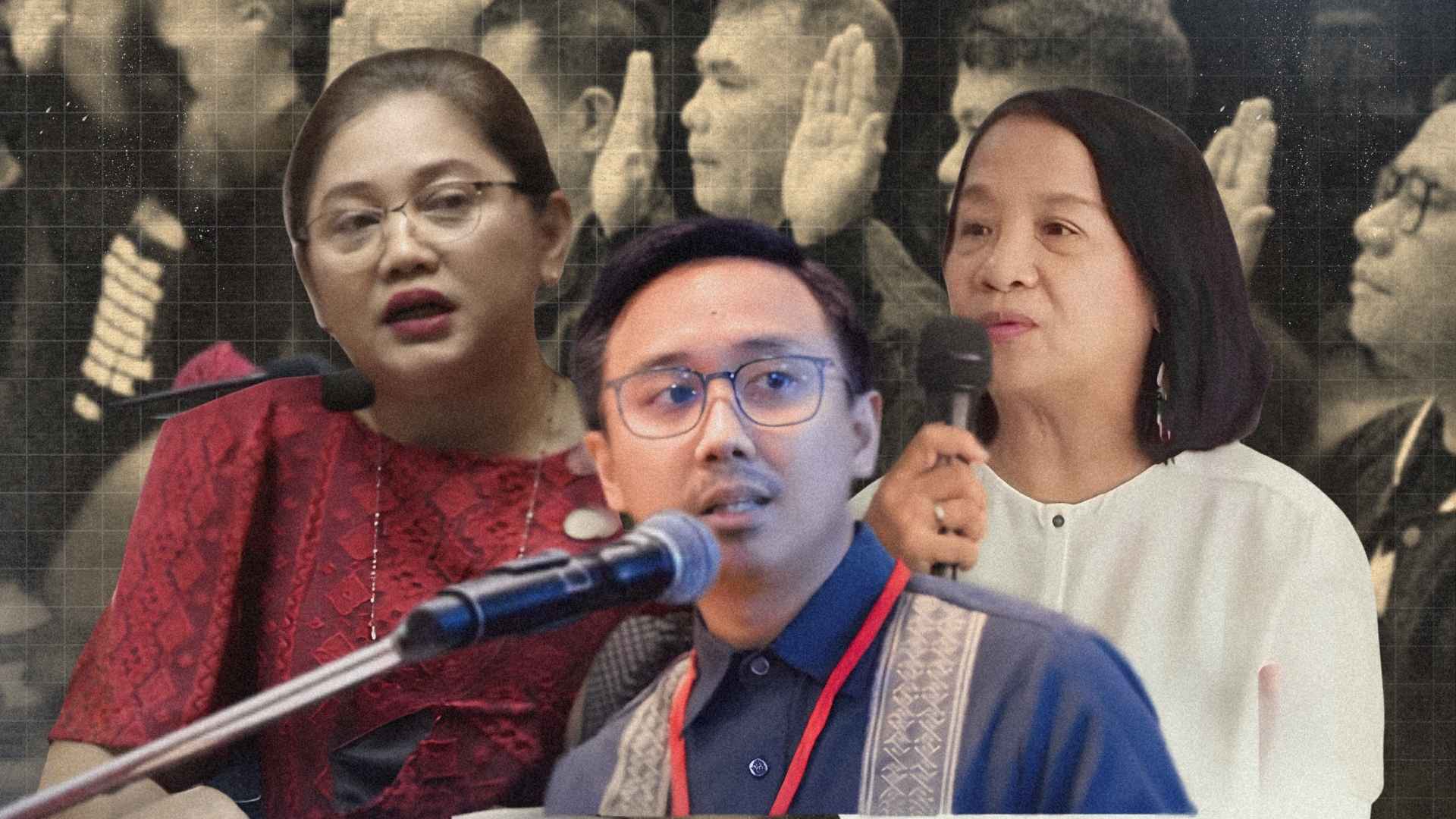
“Desperate Political Demolition”
Former Makabayan Solons Say ‘Brave 18’ Claims Aim to Protect Dutertes
The already explosive political atmosphere surrounding the “Brave 18” controversy intensified even further after former Makabayan lawmakers France Castro, Arlene Brosas, and Raoul Manuel strongly rejected allegations linking them to supposed kickbacks from the controversial flood control projects.
In a sharply worded joint statement, the three former representatives described the accusations made by the former soldiers as “malicious and baseless,” claiming the entire issue is part of a broader political demolition effort designed to protect the Duterte family.
And with impeachment tensions involving Vice President Sara Duterte continuing to escalate, the timing of the statement immediately became national conversation.
Here’s what this really means.
The flood control controversy is no longer just a corruption issue.
It has now evolved into a full-scale political narrative war involving the Senate, former lawmakers, activist groups, military-linked testimonies, impeachment politics, and even the shadow of the ICC proceedings against former President Rodrigo Duterte.
That escalation matters enormously.
Because every side is no longer simply defending itself legally.
Each side is now fighting to control public perception itself.
In their statement, Castro, Brosas, and Manuel categorically denied claims that they regularly met with businessman Zaldy Co and left carrying paper bags allegedly linked to kickbacks.
They dismissed the accusations as “outright lies” unsupported by actual evidence and argued that anyone can produce photos and create speculative narratives without proving wrongdoing in court.
The former lawmakers also stressed a crucial point politically:
They claimed Makabayan lawmakers do not control infrastructure projects and therefore could not benefit from alleged flood control kickbacks in the first place.
That argument immediately became central to their defense online.
But what truly transformed the statement into a major political flashpoint was this:
The former lawmakers directly linked the allegations to the impeachment case against Vice President Sara Duterte and the ongoing ICC proceedings involving former President Rodrigo Duterte.
According to them, the timing of the accusations was not accidental.
Instead, they framed the controversy as a deliberate diversion tactic intended to weaken critics of the Duterte family and discredit those involved in impeachment efforts.
That accusation dramatically escalates the political implications of the issue.
Because once allegations become tied to impeachment politics and ICC proceedings, the controversy moves beyond ordinary Senate hearings and enters the realm of national power struggle.
And that is exactly what many Filipinos now believe they are witnessing.
One side sees coordinated attempts to silence critics and protect powerful political allies.
Another side sees desperate efforts by opposition groups to frame every investigation as political persecution whenever allegations surface against them.
And somewhere in the middle sits the Filipino public—trying to determine which narratives are based on truth and which are driven by political survival.
This raises a bigger issue.
The Philippines is entering a period where nearly every major controversy now becomes filtered through political loyalties rather than objective facts.
Evidence itself becomes politicized.
Testimonies become factional weapons.
And institutions increasingly appear trapped between competing political camps.
That environment creates enormous distrust.
Because when every allegation immediately becomes interpreted as either “political demolition” or “cover-up,” public confidence in institutions slowly weakens.
At the same time, the former Makabayan lawmakers also accused former Senate President Alan Peter Cayetano of encouraging dangerous military targeting against activists and opposition groups.
That part of the statement reflects another growing concern inside the country:
The increasing overlap between political conflict and security rhetoric.
Historically, accusations involving activist organizations, left-leaning groups, and military narratives have carried serious implications in the Philippines. That is why statements invoking intelligence agencies and military targeting naturally generate strong reactions from both supporters and critics.
Why this matters now is because the political temperature surrounding the country continues rising rapidly.
Flood control controversies.
Senate leadership battles.
Impeachment proceedings.
ICC cases.
Military-linked allegations.
Political destabilization claims.
All these issues are now colliding simultaneously.
And in today’s hyper-polarized environment, every new statement immediately becomes fuel for competing political ecosystems online.
For supporters of the Duterte bloc, the allegations against Makabayan and impeachment-linked personalities reinforce suspicions about coordinated opposition activity.
For critics of the Duterte camp, the accusations against activists and former lawmakers appear designed to distract from deeper accountability issues involving corruption and human rights.
That division is precisely why the controversy keeps expanding.
Because this is no longer simply a debate about flood control projects.
It has become a larger national battle over power, credibility, and political survival.
And as both sides continue escalating their narratives publicly, one thing is becoming increasingly clear:
The political war surrounding the “Brave 18” controversy is far from ending.
It is only becoming more intense.
Exegesis Bible Verse
Isaiah 5:20
“Woe unto them that call evil good, and good evil; that put darkness for light, and light for darkness.”
Reflection:
In times of political confusion and competing narratives, discernment becomes essential. This verse reminds leaders and citizens alike to seek truth carefully and avoid allowing loyalty, anger, or propaganda to distort justice and accountability.
HOUSE WATCH | When Discipline Becomes the Distraction
January 16, 2026•1 min read
In heated moments, institutions often reach for procedure.
Sometimes, that reach becomes the story.
A lawmaker identified as Puno suggested that it may be time to expel Cavite 4th District Rep. Francisco "Kiko" Barzaga from the House of Representatives, following Barzaga’s escalating public accusations and floor statements tied to alleged bribery and political influence.


The remark reframes an already volatile dispute. What began as allegations and counterclaims now edges toward institutional punishment—a move that shifts attention from the substance of claims to the conduct of the claimant.
Supporters of the call argue that decorum and due process must be protected inside Congress, warning that inflammatory language can erode trust. Critics counter that expulsion talk risks changing the question—from are the allegations true? to should the accuser be removed?
Quietly, the episode underscores a recurring tension in parliamentary politics: when controversy intensifies, enforcement mechanisms can either safeguard order—or be read as silencing dissent. Which interpretation prevails often depends on what happens next: hearings, evidence, and transparency.
For now, the signal is unmistakable:
the debate has moved from microphones to the rulebook.