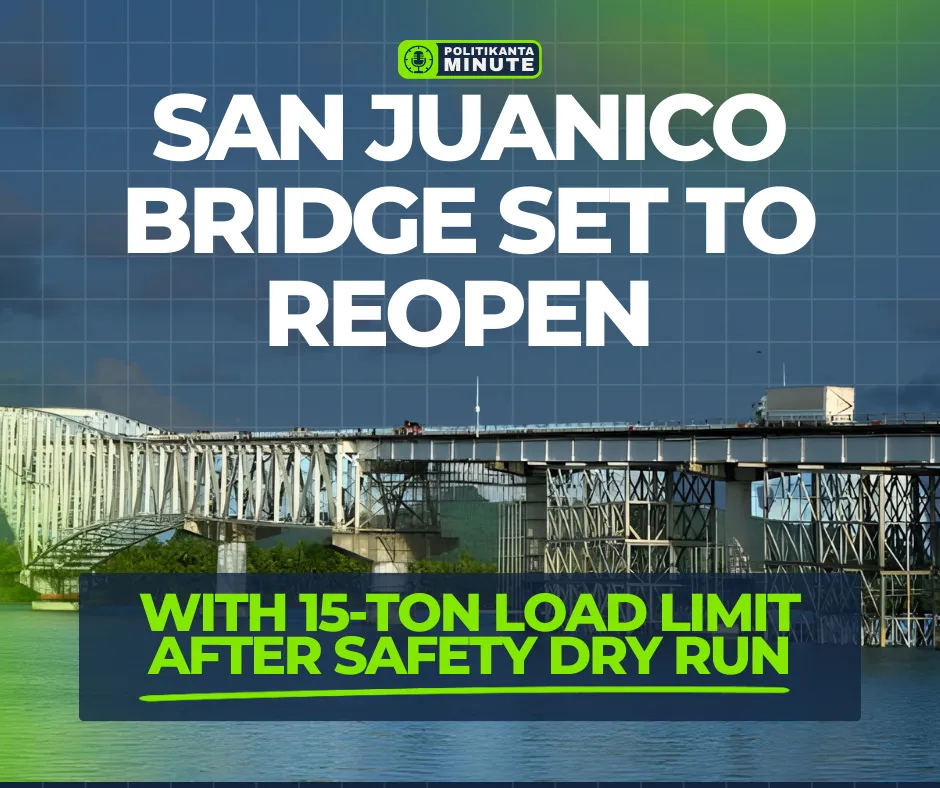
San Juanico Bridge Set to Reopen with 15-Ton Load Limit After Safety Dry Run
After months of inspection and rehabilitation, the iconic San Juanico Bridge is set to reopen with an increased 15-ton load limit, following a successful dry-run simulation conducted by the Department of Public Works and Highways (DPWH) in Eastern Visayas.
The five-hour simulation tested two-way traffic operations, speed control, and coordination among agencies, marking a critical step toward safer and more reliable passage between Leyte and Samar. Officials emphasized that the new load limit reflects engineering safety standards, not political pressure.
DPWH-8 Director Edgar Tabacon and Tacloban City Mayor Alfred Romualdez personally oversaw the operation to ensure smooth implementation and public safety. Motorists were advised to observe a 30 kph speed limit, a measure designed to protect the structural integrity of the bridge during the transition period.
The full enforcement of the 15-ton load limit is part of a broader infrastructure safety upgrade, aligning with the national government’s push for preventive maintenance instead of reactive repairs. Authorities stressed that gradual reopening, strict load control, and compliance from motorists are essential to extending the bridge’s lifespan.
President Ferdinand Marcos Jr. is expected to inspect the bridge in the coming days, underscoring the administration’s stance that public safety comes before convenience. Earlier warnings from the President made clear that failure to meet safety targets would have consequences for responsible officials—highlighting accountability in infrastructure management.
For Eastern Visayas, the reopening of San Juanico Bridge is more than a traffic update. It is a reminder that infrastructure is not just about movement, but about responsibility—to commuters, businesses, and future generations who depend on these lifelines.

🎧 Stream Sa Gitna ng Uhaw on Spotify, Amazon Music, Itunes, Youtube and Facebook today.
https://open.spotify.com/album/63hbCvGl6brB4nhEcK1z1q?si=Xj-xKgidTEOZ1WLY6Pcckw
Apple Music: https://music.apple.com/gb/album/sa-gitna-ng-uhaw/1858077981
TIDAL: https://tidal.com/album/478344566/track/478344575
Deezer: https://www.deezer.com/us/album/868511842

Upgraded Banago Port Sets a New Standard for Philippine Terminals
President Ferdinand “Bongbong” Marcos Jr. has declared the newly upgraded Banago Port in Bacolod City as the model for port terminal design across the Philippines—marking a clear push toward modernization, efficiency, and passenger-centered infrastructure.
During his inspection, the President emphasized that ports should no longer be confusing, congested, or unsafe. Instead, terminals must clearly guide passengers—from ticketing to boarding—while ensuring smooth cargo operations and safer working conditions for port personnel.
The upgraded Banago Port now features a modern Port Operations Building (POB), expanded operational areas, a widened causeway for improved traffic flow, and a covered passenger walkway designed to protect commuters from harsh weather. These upgrades are expected to significantly boost trade, tourism, and regional economic productivity in Western Visayas.
Beyond Bacolod, the President’s message was clear: infrastructure must work for people, not against them. A standardized port design allows travelers—especially those from the provinces—to move efficiently and with dignity, reducing confusion and delays that have long plagued transport hubs.
Marcos also inspected facilities at the National Maritime Polytechnic (NMP) in Tacloban City, where upgraded simulators and training equipment are set to raise the standards of Filipino seafarer education beginning 2026. This signals a parallel investment in human capital, ensuring that infrastructure development goes hand-in-hand with skills training.
In a country dependent on maritime transport, modern ports are not luxuries—they are necessities. The Banago Port upgrade represents a shift toward functional governance, where infrastructure directly supports economic mobility, safety, and national growth.
