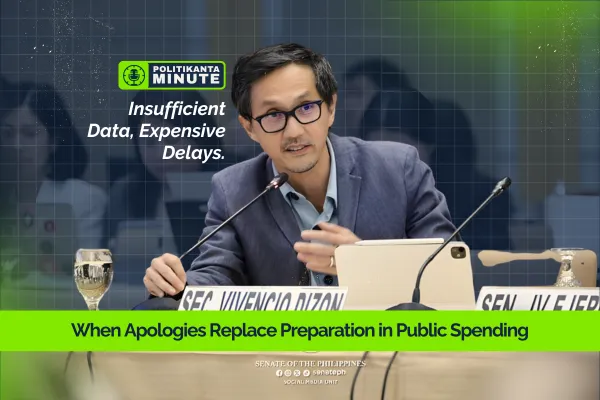
Insufficient Data’: When Apologies Replace Preparation in Public Spending
The Department of Public Works and Highways (DPWH) has issued an apology for submitting insufficient initial data to the Senate during bicameral discussions on the 2026 national budget, contributing to a legislative deadlock.

According to DPWH officials, the lack of complete information—particularly on the application of updated construction material price data—limited the Senate’s ability to evaluate proposed adjustments properly.
The apology was polite.
The problem is structural.
Because budgets are not built on good intentions—they are built on credible data, readiness, and transparency.
📖 “Plans fail for lack of counsel, but with many advisers they succeed.” — Proverbs 20:18
The Eagle sees a pattern emerging.
First, projects are approved despite being unready.
Then, data arrives incomplete.
Finally, apologies are issued—after delays, reductions, and public backlash.
DPWH insists it is working to improve transparency and technical integrity, promising to refine submissions and align future proposals with Senate requirements. Yet lawmakers remain cautious, pointing out that insufficient data is not a minor clerical error—it affects billions of pesos and national priorities.
In public finance, missing data is not neutral.
It skews decisions.
It weakens oversight.
And it erodes trust.
An apology may reset the tone, but it does not fix the system.
The real question is no longer who is sorry, but why the same readiness gaps keep repeating—year after year, budget after budget.
Because when preparation fails, governance stalls.
And when governance stalls, the public pays the cost.

New Faces, Same Test: Can ‘Young Blood’ Fix a Broken System?
Public Works Secretary Vince Dizon has introduced young blood engineers as the new officers in charge of the controversial Bulacan 1st District Engineering Office, following the flood-control scandal that rocked the agency.

“We’re not here for money, but for solutions,” Dizon said—framing the move as a reset, a chance to restore credibility and competence within DPWH.
On paper, the message sounds hopeful.
Fresh minds. Clean slates. No baggage.
But the Eagle asks a harder question:
Is replacing faces enough when the system itself remains untouched?
Flood-control failures are rarely the work of a single office—or a single generation. They are the result of longstanding processes, weak oversight, and incentives that reward compliance over courage.
Young engineers may bring integrity.
They may bring idealism.
But idealism alone cannot survive inside a structure that resists transparency.

🎧 Stream Sa Gitna ng Uhaw on Spotify, Amazon Music, Itunes, Youtube and Facebook today.
https://open.spotify.com/album/63hbCvGl6brB4nhEcK1z1q?si=Xj-xKgidTEOZ1WLY6Pcckw
Apple Music: https://music.apple.com/gb/album/sa-gitna-ng-uhaw/1858077981
TIDAL: https://tidal.com/album/478344566/track/478344575
Deezer: https://www.deezer.com/us/album/868511842
📖 “Do not pour new wine into old wineskins.” — Luke 5:37
Leadership is not just about appointing new people.
It is about changing how decisions are made, how projects are approved, and how money is tracked.
If these young officers are truly empowered—protected from political pressure, shielded from coercion, and backed by firm accountability—then reform has a chance.
But if they are merely placed at the front while old habits operate behind the scenes, then this becomes not reform—but rebranding.
The country has seen this pattern before:
New faces introduced, scandals fade, systems stay intact.
This moment will matter not because of who was appointed—but because of what happens when they refuse to follow old instructions.