
Support Politikanta Minute
Your support keeps independent commentary alive.
☕ Buy us a coffee and keep the conversation going
Latest Videos
Curated Politikanta Minute playlists by focused political topic.
BBM Issues
Latest BBM-related updates, reactions, political tension, hearing clips, and issue breakdowns.
Watch MoreDuterte Legacy Playlist
Senate Circus Playlist
House of Representatives Scandals Playlist
18 Marines Playlist
Global Entertainment Playlist
Global News Playlist
Bible Scripture Playlist
Breaking News Playlist

Mike Defensor Appears Before Sandiganbayan, Questions Why Romualdez and Zaldy Co Are Not Detained
Mike Defensor Appears Before Sandiganbayan for Plunder Hearing
Former congressman Mike Defensor appeared before the Sandiganbayan on Wednesday morning for the continuation of proceedings in his plunder case before the anti-graft court's Third Division.
As he entered the courthouse, Defensor made a brief public statement questioning why other public officials he mentioned have not faced the same circumstances.
"Si Martin Romualdez at Zaldy Co, 'di pa rin nakukulong."
The remark was made as members of the media covered his arrival at the Sandiganbayan.
Court Proceedings Continue
Defensor's appearance formed part of the ongoing judicial process involving the charges filed against him.
The Sandiganbayan is scheduled to hear matters related to the plunder case, with court proceedings continuing under the regular rules governing criminal trials before the anti-graft court.
At this stage, the court has not rendered a final judgment on the allegations.
Statement Draws Attention to Broader Accountability Issue
Defensor's remarks referenced House Speaker Martin Romualdez and Ako Bicol Party-list Rep. Zaldy Co, whose names have figured in recent public discussions concerning flood control projects.
His statement reflected his personal view regarding accountability but did not include specific legal allegations presented during Wednesday's court proceedings.
Any separate investigations or complaints involving other individuals remain subject to their own legal processes and applicable constitutional protections.
Presumption of Innocence Applies
As with all criminal proceedings, the case against Defensor remains pending before the court.
Under Philippine law, all accused persons are presumed innocent unless proven guilty beyond reasonable doubt after the completion of judicial proceedings.
Similarly, individuals mentioned in public statements remain entitled to due process unless and until competent authorities determine otherwise.
Reportorial Commentary
Mike Defensor's remarks outside the Sandiganbayan underscore how ongoing legal proceedings often intersect with broader public debates about accountability in government. While his statement drew attention to other personalities who have been publicly linked to discussions surrounding flood control projects, such comments do not constitute judicial findings.
The courts will determine Defensor's criminal liability based solely on the evidence presented in his case. Likewise, any allegations involving other public officials must be evaluated independently through the appropriate investigative and judicial processes.
Maintaining the distinction between public commentary and legal adjudication remains essential to preserving due process and the rule of law.
Bible Verse & Exegesis
"Do not pervert justice; do not show partiality or accept a bribe." — Deuteronomy 16:19 (NIV)
Exegesis
This passage emphasizes that justice should be administered impartially, without favoritism or prejudice. In democratic societies governed by the rule of law, accountability must be determined through fair investigations, credible evidence, and independent courts—not by public perception alone. The principle reminds both officials and citizens that justice is best served when every person is afforded equal treatment and due process under the law.
An Open Letter, A Fractured Trust: When Loyalty, Power, and Free Speech Collide
December 21, 2025•2 min read
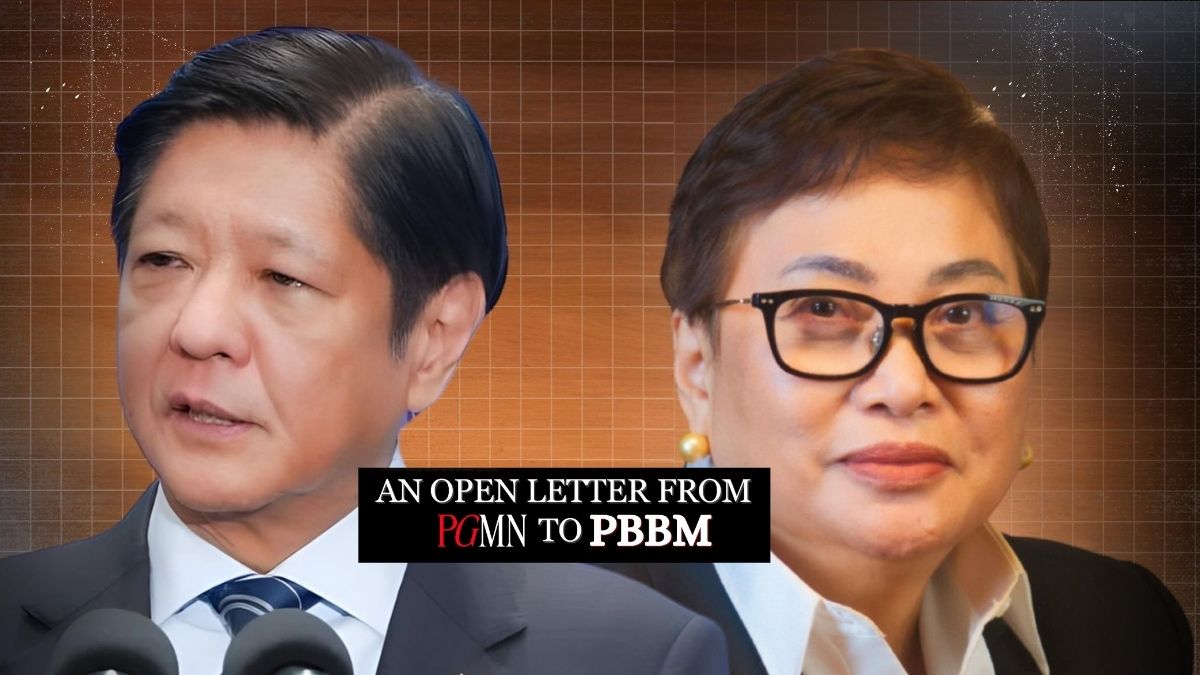
An open letter released by Peanut Gallery Media Network addressed to President Ferdinand Marcos Jr. has ignited renewed discussion about loyalty, free speech, and the growing disconnect between leadership and public sentiment.

The letter, written by PGMN’s founder, presents itself not as an attack, but as a deeply personal reflection — one rooted in years of political engagement, shared history, and uneasy realizations. It speaks from a space of conflicted loyalty: loyalty to principles, to free expression, and once, to the President himself.
At the heart of the message is discomfort. The writer describes watching the final cut of a political episode featuring Rowena Guanzon, an outspoken critic of the administration. Instead of silencing or shelving the episode, the decision was made to release it — not out of provocation, but out of principle.
This choice highlights a deeper issue now resonating across Filipino discourse: the widening gap between those in power and the people who once believed in them.
From Loyalty to Unease
The letter traces a long political journey — from building digital infrastructures during times of online suppression to surviving the era of heavy platform censorship. It recalls years when political voices were muted, shadowbanned, or erased altogether for deviating from acceptable narratives.
Ironically, the freedom once fought for is now being tested from within.
The author emphasizes that loyalty should not require silence, and friendship should not demand blind defense. True loyalty, the letter suggests, allows room for criticism — especially when governance decisions feel disconnected from everyday realities.

The Core Tension: Planning vs. Reality
One recurring theme in public frustration today is the perception that the government appears over-focused on long-term visions while current crises remain unresolved. Repeated reshuffling of officials, changing strategies, and grand development roadmaps contrast sharply with persistent inflation, employment concerns, healthcare gaps, and disaster response failures.
The letter does not deny the value of planning. Instead, it questions whether planning without visible progress risks becoming performative — a political comfort rather than a public solution.
Free Speech as the Final Line
Perhaps the most powerful assertion in the letter is this: free speech only matters when it protects voices we disagree with.
The decision to publish content critical of the President is framed not as rebellion, but as a test of democratic maturity. If media organizations fear retaliation for honest critique, the letter warns, then freedom becomes conditional — and democracy fragile.
A Nation Waiting for Reconnection
The letter closes not with condemnation, but with a cautious hope. Hope that leadership can still recalibrate. Hope that listening replaces distancing. Hope that governance once again aligns with lived realities.
For many Filipinos, this open letter reflects a quiet but growing sentiment: people are not asking for perfection — they are asking to be seen, heard, and helped today, not promised tomorrow.



More BBM Stories
FOLLOW US


Disclaimer: This site uses publicly available images and materials for news, satire, and commentary. All rights belong to their respective owners. No copyright infringement intended.
© 2025 Politikanta Minute. All Rights Reserved.
Political Commentary • Satire • Faith-Based Reflection
Some visuals may be AI-generated for satire and illustration. Not real footage unless stated.
FOLLOW US
Disclaimer: This site uses publicly available images and materials for news, satire, and commentary. All rights belong to their respective owners. No copyright infringement intended.
© 2025 Politikanta Minute. All Rights Reserved.
Political Commentary • Satire • Faith-Based Reflection
Some visuals may be AI-generated for satire and illustration. Not real footage unless stated.
FOLLOW US
Disclaimer: This site uses publicly available images and materials for news, satire, and commentary. All rights belong to their respective owners. No copyright infringement intended.
© 2025 Politikanta Minute. All Rights Reserved.
Powered by Graprix Design and Prints.
Political Commentary • Satire • News • Faith & Devotion