
Support Politikanta Minute
Your support keeps independent commentary alive.
☕ Buy us a coffee and keep the conversation going
Latest Videos
Curated Politikanta Minute playlists by focused political topic.
HOR Issues
Latest HOR-related updates, reactions, political tension, hearing clips, and issue breakdowns.
Watch MoreDuterte Legacy Playlist
Senate Circus Playlist
House of Representatives Scandals Playlist
Celebrity Updates
Sports
🎵 Music
18 Marines Playlist
Global Entertainment Playlist
Global News Playlist
Bible Scripture Playlist
Breaking News Playlist
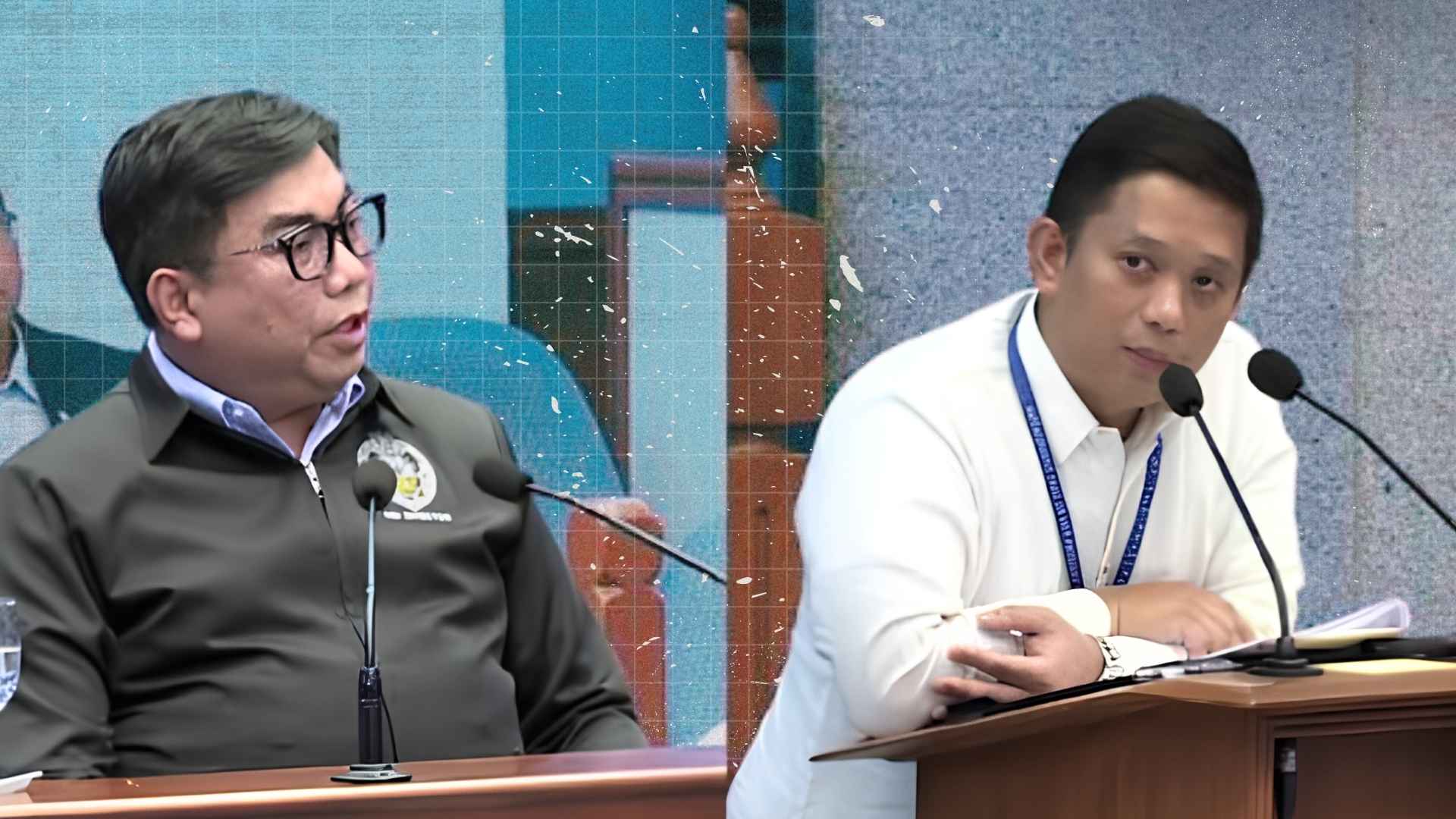
“CHISMIS LANG?” VINLUAN PRESSES MATIBAG ON PERSONAL KNOWLEDGE
VINLUAN PRESSES MATIBAG ON “PERSONAL KNOWLEDGE”: “KUNG WALA KANG PERSONAL KNOWLEDGE, CHISMIS LANG?”
Defense Challenges NBI Chief's Testimony Based on Records, but Prosecution Points to Exceptions Under Rules of Evidence
The impeachment trial of Vice President Sara Duterte once again turned into a heated discussion over the rules of evidence as defense counsel Atty. Mark Vinluan questioned NBI Director Melvin Matibag about the limits of a witness's personal knowledge.
The exchange focused on a fundamental question:
Can a witness testify about events that happened before he personally became involved in an investigation?
Vinluan pointed out that Matibag assumed his current position only in February 2026. Before that, according to Matibag, his knowledge of the earlier investigation came from news reports and official records—not from his own personal participation.
Vinluan then directed Matibag to Rule 130, Section 22 of the Rules of Evidence, which provides that a witness generally testifies only about facts within his or her personal knowledge—meaning facts derived from the witness's own perception.
After reading the rule, Vinluan asked Matibag whether a witness can testify only on the basis of personal knowledge.
Matibag agreed—but immediately added an important qualification.
There are exceptions to the rule.
That answer triggered an intervention from the prosecution.
The lead prosecutor explained that Matibag's testimony concerning the earlier investigation was based on official records. The prosecution argued that entries in official records may be considered prima facie evidence of the facts stated in them, subject to the applicable rules.
The presiding officer also stepped in.
He acknowledged that Vinluan was attempting to establish a particular point regarding the basis of Matibag's testimony and allowed the defense counsel some leeway to continue.
But the presiding officer also reminded Vinluan to move on to the next topic once he had sufficiently established his argument.
Vinluan then returned to his central question.
If a witness is not testifying from personal knowledge, does that make the testimony hearsay?
Matibag again pointed out that the rule is not absolute because there are exceptions.
And this is where the exchange became particularly interesting.
Vinluan then asked for the Filipino translation of “hearsay.”
After some back-and-forth, he jokingly suggested:
“Sabi-sabi or chismis?”
Matibag declined to give a translation.
Vinluan then offered his own informal interpretation.
“Kung wala kang personal knowledge, chismis lang 'yun, tama?”
Matibag, however, did not simply accept that characterization.
He maintained that he was not familiar with hearsay being translated in court as “tsismis” and that, in any event, the legal concept involves exceptions.
And that distinction is important.
Because in ordinary conversation, “chismis” may be used to describe information passed from one person to another.
But legally, hearsay is a technical concept.
The mere fact that a witness did not personally see or hear something does not automatically mean that every statement based on outside information is inadmissible.
The rules of evidence recognize circumstances where information from another source may still be considered, depending on the applicable exception and the purpose for which the information is being presented.
That is precisely the point the prosecution was making.
The defense is challenging Matibag's personal knowledge of events that occurred before he became NBI director.
The prosecution's response is essentially:
Matibag may not have personally witnessed the earlier events, but he can testify about official records and investigative documents that he reviewed, subject to the rules governing their admissibility and evidentiary value.
So the real issue is not simply:
“Did Matibag personally witness it?”
The deeper question is:
“What is the legal basis for Matibag's knowledge, and is that basis sufficient under the rules of evidence?”
That is a much more complicated question than simply calling something “chismis.”
And this is where the defense's line of questioning becomes strategically significant.
If Matibag's testimony about the original investigation is based entirely on records, the defense can challenge whether he has sufficient personal knowledge to independently establish the truth of the matters contained in those records.
The prosecution, meanwhile, can argue that official records and other recognized exceptions provide a legitimate basis for presenting information that the witness did not personally observe.
The distinction could ultimately affect how much weight the senator-judges give to Matibag's testimony.
And that's the key point.
The debate isn't simply about whether Matibag is telling the truth.
It's about how he knows what he claims to know.
In an impeachment trial, that distinction can be crucial.
Because there is a difference between saying:
“I personally witnessed this happen.”
And saying:
“I reviewed the official records documenting what happened.”
Those are not the same thing.
The first is direct personal knowledge.
The second relies on documentary evidence and the rules that govern its use.
So while Vinluan's “chismis” remark made the exchange memorable, the actual legal question underneath it is far more serious.
What is the evidentiary foundation of Matibag's testimony?
And can the prosecution establish the facts it needs to prove through records that the witness himself did not personally create or witness?
That's the battle happening inside this impeachment trial.
Not just what the witness knows.
But how he knows it.
And ultimately, whether the rules of evidence allow the court to rely on it.
📖 EXEGESIS — “EVERY MATTER MUST BE ESTABLISHED BY THE TESTIMONY OF TWO OR THREE WITNESSES”
2 Corinthians 13:1
“Every matter must be established by the testimony of two or three witnesses.”
The principle behind this verse is simple but powerful:
Serious claims require serious verification.
In any proceeding where people's rights, reputations, and accountability are at stake, one should never rely carelessly on unverified information.
The impeachment trial raises questions that demand careful examination.
Who personally witnessed what happened?
What information came from official records?
Which claims can be independently corroborated?
And what evidence can withstand cross-examination?
The exchange between Atty. Mark Vinluan and NBI Director Melvin Matibag reminds us that truth should not be established merely by repeating what someone else said.
It should be tested.
It should be examined.
And where possible, it should be independently confirmed.
Because when the stakes are this high, the difference between personal knowledge and secondhand information matters.
Justice requires more than believing the first story we hear.
It requires us to seek the truth carefully and honestly.
SWS Survey Shows Diverging Trust Paths: Marcos at –3%, VP Sara Duterte at +31%
December 26, 2025•1 min read
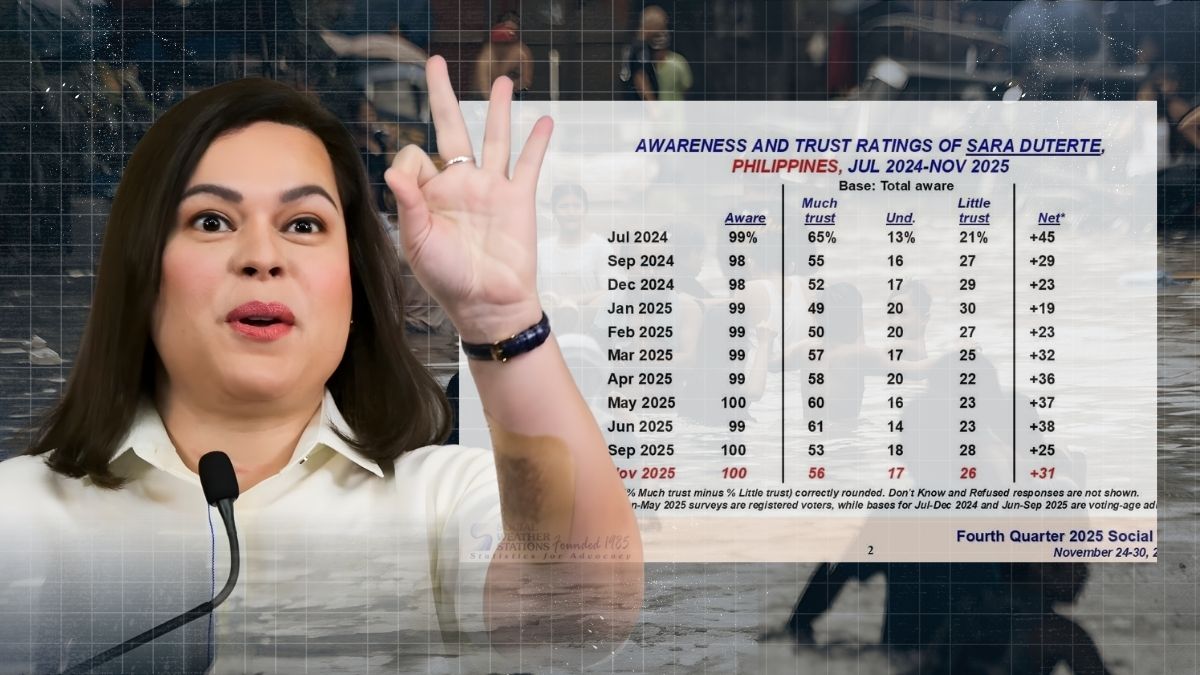
The latest Social Weather Stations (SWS) survey reveals a clear divergence in public trust among the country’s top leaders, with President Ferdinand Marcos Jr. registering a –3% net trust rating, while Vice President Sara Duterte climbed to a solid +31%.

According to the November 24–30, 2025 survey, President Marcos recorded 38% “much trust” against 41% “little trust,” pushing his net trust into negative territory. This marks a continued decline from his +7% rating in October 2025, signaling growing public dissatisfaction.
In contrast, Vice President Duterte posted 56% “much trust” versus 26% “little trust,” resulting in a +31% net trust score—a notable increase amid political turbulence and sustained scrutiny.
Analysts note that trust ratings often reflect perceived steadiness under pressure rather than day-to-day headlines. While the President faces backlash linked to governance controversies and unresolved national issues, the Vice President’s numbers suggest that a segment of the public views her as consistent, restrained, and grounded, even amid legal and political noise.
Importantly, SWS net trust ratings measure sentiment, not election outcomes. Still, the contrast highlights a shift in public mood—one that rewards composure and penalizes uncertainty.
🦅 Agila note:
Trust does not rise from speeches alone. It grows quietly where people see steadiness, not spin.
Bible Verse:
“A good name is more desirable than great riches; to be esteemed is better than silver or gold.” — Proverbs 22:1





More House of Representa’thieves Stories
FOLLOW US
Disclaimer: This site uses publicly available images and materials for news, satire, and commentary. All rights belong to their respective owners. No copyright infringement intended.
© 2025 Politikanta Minute. All Rights Reserved.
Political Commentary • Satire • Faith-Based Reflection
Some visuals may be AI-generated for satire and illustration. Not real footage unless stated.
FOLLOW US
Disclaimer: This site uses publicly available images and materials for news, satire, and commentary. All rights belong to their respective owners. No copyright infringement intended.
© 2025 Politikanta Minute. All Rights Reserved.
Political Commentary • Satire • Faith-Based Reflection
Some visuals may be AI-generated for satire and illustration. Not real footage unless stated.