
Daily devotions, prayers, and worship—anchoring your heart in God’s truth amid everything happening in our world and nation.
Strength for Today, Light for Every Battle.
Support Politikanta Minute
Your support keeps independent commentary alive.
☕ Buy us a coffee and keep the conversation going
Daily devotions, prayers, and worship—anchoring your heart in God’s truth amid everything happening in our world and nation.
Strength for Today, Light for Every Battle.
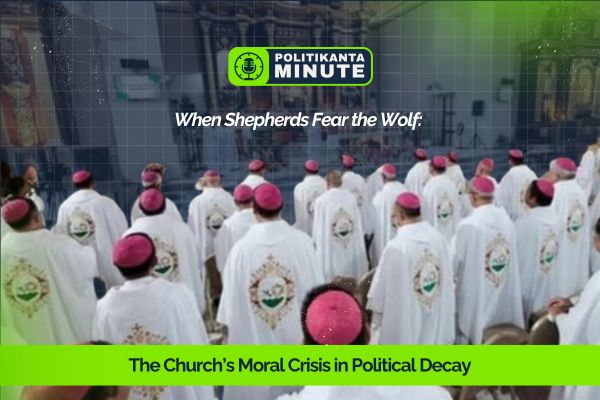
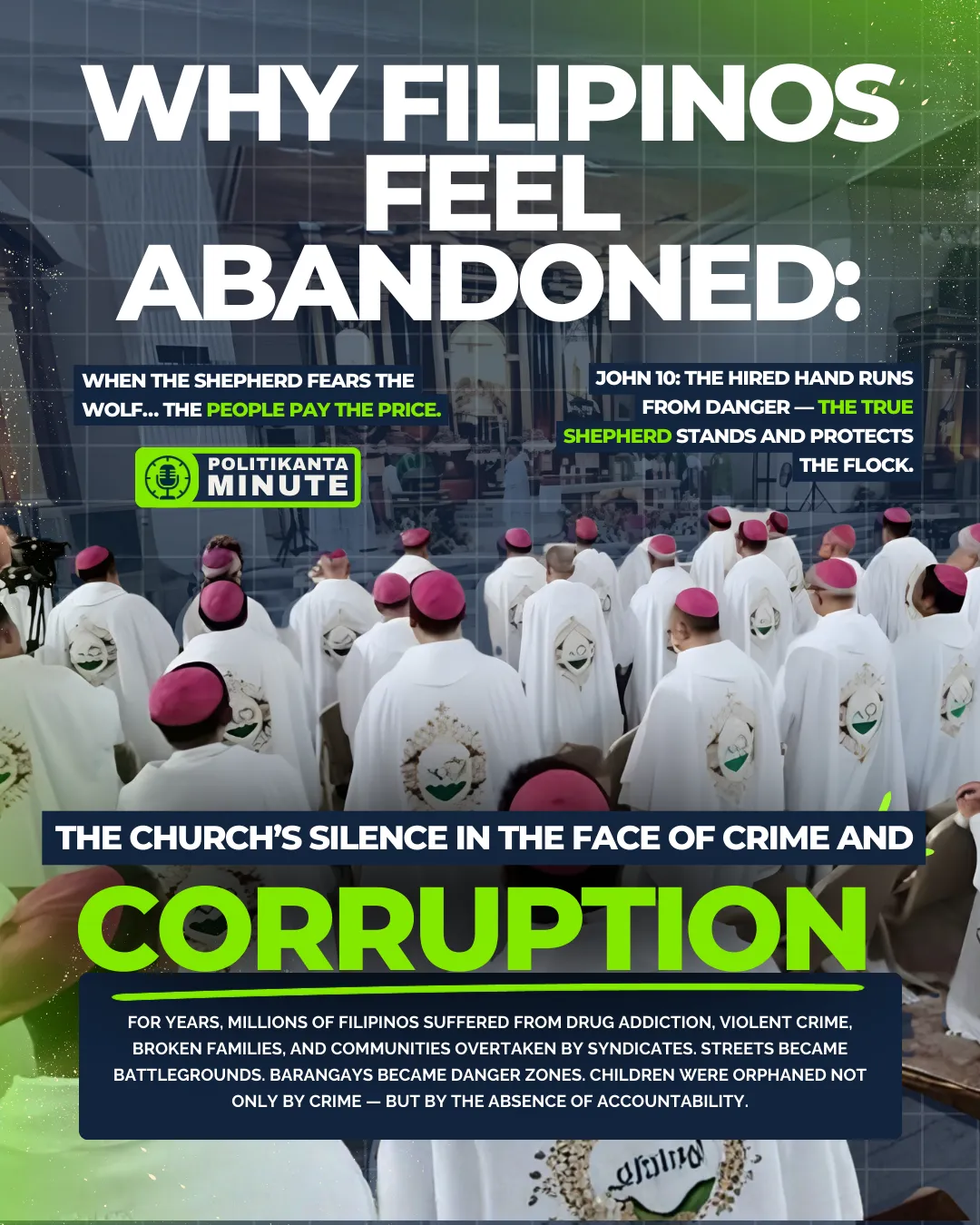
When Shepherds Drop the Staff: The Church’s Silence in a Nation That Needed Courage
In every generation, God raises shepherds to protect the flock from wolves.
But what happens when the shepherd starts fearing the wolf…
and the flock is left to survive on its own?

For years, millions of Filipinos suffered from drug addiction, violent crime, broken families, and communities overtaken by syndicates. Streets became battlegrounds. Barangays became danger zones. Children were orphaned not only by crime — but by the absence of accountability.
And instead of standing with the people,
instead of confronting the wolves tearing the nation apart,
much of the institutional Church chose silence.
This is what people call the “failure of the shepherd.”
They spoke loudly against the government’s attempts to restore order…
yet spoke softly about the drug lords who destroyed countless families.
They condemned leaders who fought criminal syndicates…
yet rarely confronted the syndicates themselves.
They preached peace —
yet were silent in the face of the violence ordinary Filipinos lived with every day.
Scripture is clear:
“A hired hand runs away because he does not care for the sheep.” — John 10:12–13
A true shepherd protects.
A true shepherd confronts the wolf.
A true shepherd stands with the people, not with political noise.
And in times of corruption, injustice, and moral decay, the Church should have been a voice of clarity —
not confusion.
That is why many Filipinos now feel the institution has lost moral weight.
Because when the people were crying for help,
when families were under attack,
when corruption climbed to the highest levels…
the shepherd feared the wolf more than they feared failing the flock.
But there is hope.
This moment should awaken every leader — religious or political — to return to courage, truth, and accountability.
Because a nation can forgive mistakes,
but it cannot survive leaders — spiritual or political — who refuse to confront evil.
May this season be a reminder:
God is still looking for shepherds with courage, not titles.

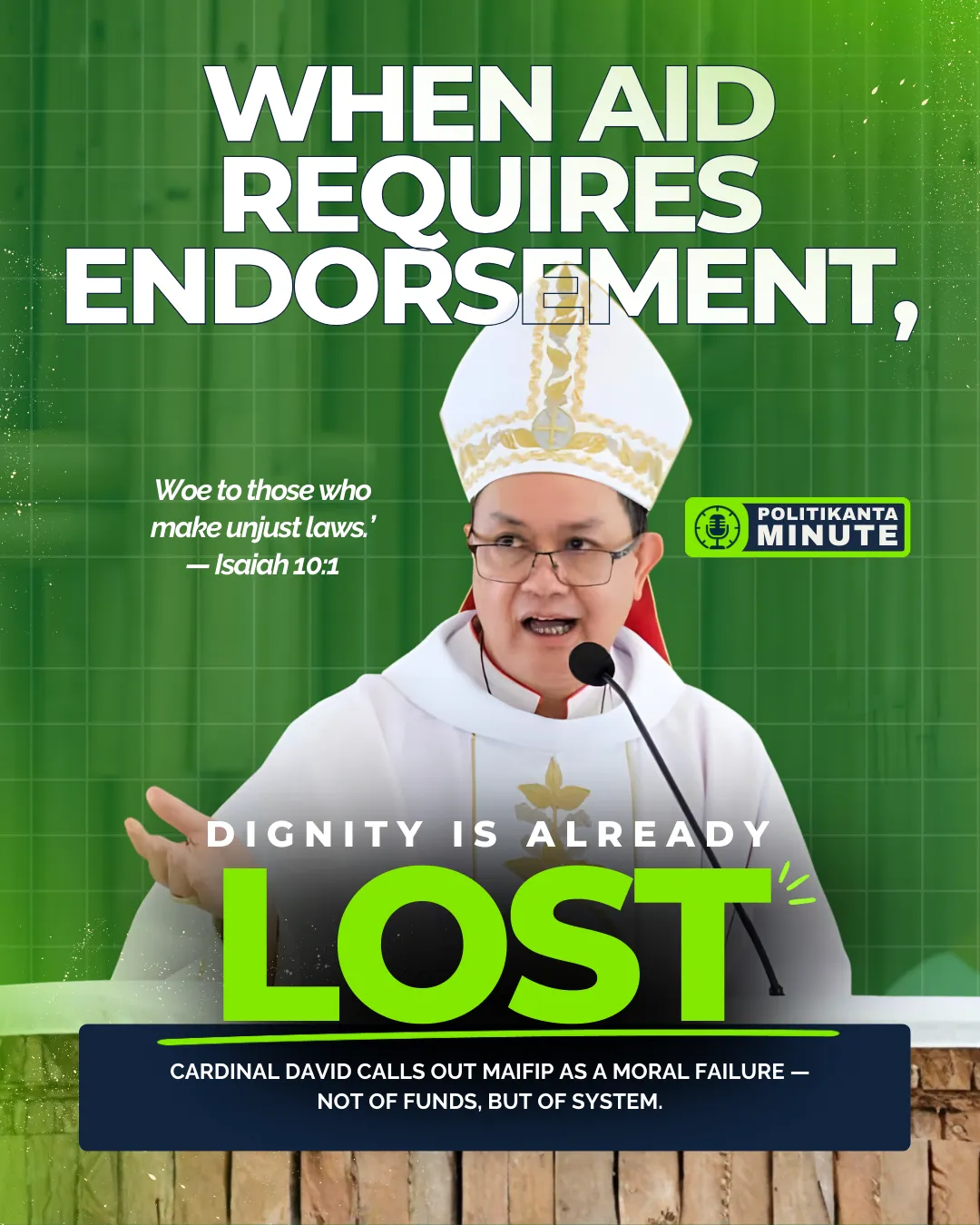
Dignity, Not Endorsements: When Aid Becomes a Tool of Control
Cardinal Pablo Virgilio David has once again struck a nerve — and this time, the wound is moral.
Calling the MAIFIP budget hike a “violation of human dignity,” the Cardinal exposed a truth many Filipinos quietly live with:
when access to health care depends on a politician’s signature, dignity is already lost.

MAIFIP, on paper, sounds compassionate.
In practice, it risks becoming another health pork barrel — aid dispensed not by need, but by loyalty.
Not by urgency, but by endorsement.
Not by rights, but by gratitude politics.
And that’s the danger.
The Cardinal warned that systems like these normalize begging — forcing the poor to ask favors for services they are already entitled to as citizens. That is not charity. That is control.

🎧 Stream Sa Gitna ng Uhaw on Spotify, Amazon Music, Itunes, Youtube and Facebook today.
https://open.spotify.com/album/63hbCvGl6brB4nhEcK1z1q?si=Xj-xKgidTEOZ1WLY6Pcckw
Apple Music: https://music.apple.com/gb/album/sa-gitna-ng-uhaw/1858077981
TIDAL: https://tidal.com/album/478344566/track/478344575
Deezer: https://www.deezer.com/us/album/868511842
Scripture speaks plainly:
“Woe to those who make unjust laws… who deprive the poor of their rights.” — Isaiah 10:1–2
A government that truly serves does not make the sick line up for signatures.
A just system does not turn illness into a campaign opportunity.
And a dignified society does not teach its poorest citizens that survival depends on knowing the right politician.
Here’s the uncomfortable question many are now asking:
Why expand discretionary aid programs when PhilHealth and DOH systems already exist to deliver universal care — without political mediation?
Under past reforms, health services were meant to be institutional, automatic, and dignified.
But when politicians reinsert themselves into the process, aid stops being public service and becomes utang-na-loob politics.
This is where faith must speak — not as opposition, but as conscience.
The Cardinal’s message is not anti-government.
It is anti-humiliation.
Anti-dependence.
Anti-systems that quietly train citizens to kneel instead of stand.
Because when the poor are taught to beg for what is rightfully theirs,
the problem is no longer budget size —
the problem is the soul of governance itself.
A nation restores dignity not by louder speeches,
but by building systems where help is given because it is just — not because someone endorsed it.





FOLLOW US


Disclaimer: This site uses publicly available images and materials for news, satire, and commentary. All rights belong to their respective owners. No copyright infringement intended.
© 2025 Politikanta Minute. All Rights Reserved.
Political Commentary • Satire • Faith-Based Reflection
Some visuals may be AI-generated for satire and illustration. Not real footage unless stated.